"Those in possession of absolute power can not only
prophesy and make their prophecies come true, but they can also lie and
make their lies come true." - Eric Hoffer, American philosopher
(1902-1983)
As humanity continues its slow, stuttering but ever-onward march into
its technocratic future – ambling obliviously toward the tripwires of
digital IDs, AI-driven surveillance and eventually, carbon-based social
credit systems – so too has civilization come to resemble the kind of
dystopias that were once confined to the pages of fiction.
These
have often proved chilling in their prescience. With western
governments’ ongoing assault on free speech and the systematic erasure
of their national identities, the book-burning culturicide of Ray
Bradbury’s Fahrenheit 451 has seldom felt more tangible. The societal atomization and moral anemia articulated in A Clockwork Orange are now all but endemic to the modern metropolis while even younger readers must recognize, in the open-air prison ghettos of the The Hunger Games, foundations of the 15-minute cities being erected around us
– Isaac Asimov, Yevgeny Zamyatin, and Philip K. Dick all penning
despotic, dehumanizing depictions of technologies which have since
pervaded every facet of our lives.
But while tyranny
and the threat of tyranny has always loomed large in literary
consciousness, within the wider public debate (and in particular, along
the frontlines of social media) it remains George Orwell who epitomizes
our collective fear of megalomaniacal authority. I have written before
about the enduring relevance of 1984, specifically in relation to the transgender delusion
and yet, upon delving into the life of its author, certain realities
arise which would seem to undermine Orwell’s legacy as an
anti-establishment folk hero – no reality more troubling or more telling
than his ties to the British Fabian Society.
What is the Fabian Society?
Perhaps unsurprisingly, the most charitable answer to this question comes from the organization themselves, their website proclaiming, in conspicuously banal, obscurantist language:
“…The
Fabian Society is an independent left-leaning think tank and a
democratic membership society. We influence political and public
thinking and provide a space for broad and open-minded debate. We
publish insight, analysis, and opinion; conduct research and undertake
major policy inquiries; convene conferences, speaker meetings and
roundtables; and facilitate member debate and activism across the UK.”
This, needless to say, scarcely scratches the surface. After all, today’s Fabians – a coterie comprised of figures such as former president Bill Clinton and British Prime Minister Keir Starmer – can trace their ideological lineage as far back as Thomas Davidson,
a 19th Century Scottish theologian whose year-and-a-half residence in
an Italian monastery would see him immersed in the works of Antonio Rosmini,
a priest heralded as one of the earliest pioneers in Social Justice.
Imbued with such ideas, the itinerant philosopher returned to England
with no less than the intent of "reorganizing human life,” his Fellowship of the New Life
established in the hope of doing just that. Among attendees were those
of an unequivocally socialistic bent – individuals who subscribed to the
fundamental tenants of Davidson’s worldview but who regarded his
commitment to volunteerism as fanciful, impractical and rudderless. A
brief rift ensued and on January 4th, 1884, nine of these malcontents
officially broke from the Fellowship of the New Life in order to conduct
what would come to be recognized as the first meeting of the Fabian
Society.
Their aims were more expressly political. It was the contention of eugenicists Sidney and Beatrice Webb, dissident sexologist Havelock Ellis, infamous libertine Hubert Bland,
alongside the other cofounders, that the state’s most essential
function should be to act on behalf of society, a maxim which would
translate to progressive taxes, the heavy-handed redress of inequality,
and by extension, an all-encompassing welfare system designed to
liberate the common man from the shackles of his poverty. Not that they
foresaw the common man as having any role in governance, however. This
duty would instead fall on an enlightened and benevolent cadre of
experts, a moral and intellectual aristocracy who were both committed to
and uniquely capable of, the unwavering scientific rationality
underpinning the Fabian’s proposed utopia. In other words, themselves.
Mindset and Methodology
Not
that this aspiring intelligentsia were under any illusions about how
palatable such ideas were within Victorian-era Britain. During their
inaugural meeting, before even the fledgling think tank had a name,
members were discussing just this problem when author and spiritualist
Frank Podmore stood up. Relaying the story of Quintus Fabius,
he described how the Roman general had earned the epithet of ‘The
Procrastinator’ during the Second Punic War, after a decisive victory at
Lake Trasimene had allowed Carthaginian forces to occupy much of the
Italian Peninsula – a presence they would maintain for the next
seventeen years. Still, Fabius refused to engage. Recognizing the
military supremacy of his enemy, Fabius ignored Hannibal’s provocations
as well as the near wholesale condemnation from his consuls to instead
embark upon a war of attrition, seeking to wear the invaders down
through minor skirmishes and continual, low-level harassment. It was
through such a gradualist approach, Podmore maintained, that the Fabians
(as they would henceforth be known) might one day see their vision of
English Socialism become a reality.
Such reticence
was not misplaced. At the time, the only significant forces within
British politics were the Conservative and Liberal Parties, neither of
which offered a viable outlet for Fabian ambitions. Lacking any
readymade pathway to Parliament, Webb, Podmore et al. set about engaging
England’s disparate network of trade unions and leftist movements,
their efforts ultimately culminating in the formation of The Labour
Party. But their influence was more than just coordinative. By their own
admission, the Fabians regarded themselves as Labour’s “brainworkers”
and the “thinking machine of British Socialism,”
writing not just the party’s manifestos and policy papers but also its
founding constitution, the elitism espoused in the privacy of their
gatherings draped publicly in rabble-rousing rhetoric and slogans of
working-class solidarity.
Curiously enough, for a
movement built so explicitly on duplicity, the Fabians have proved
remarkably unguarded in acknowledging their tactics. Shown above is the
society’s first coat of arms – a wolf in sheep clothing – a fitting but
fatally evocative image since scrapped for reasons of optics. Throughout
their history, the group have also marched under the banner of a turtle
proclaiming “when I strike, I strike hard,”
another allusion to their patient approach to revolution, and yet,
arguably the most graphic illustration of their subversive nature
remains proudly on display.
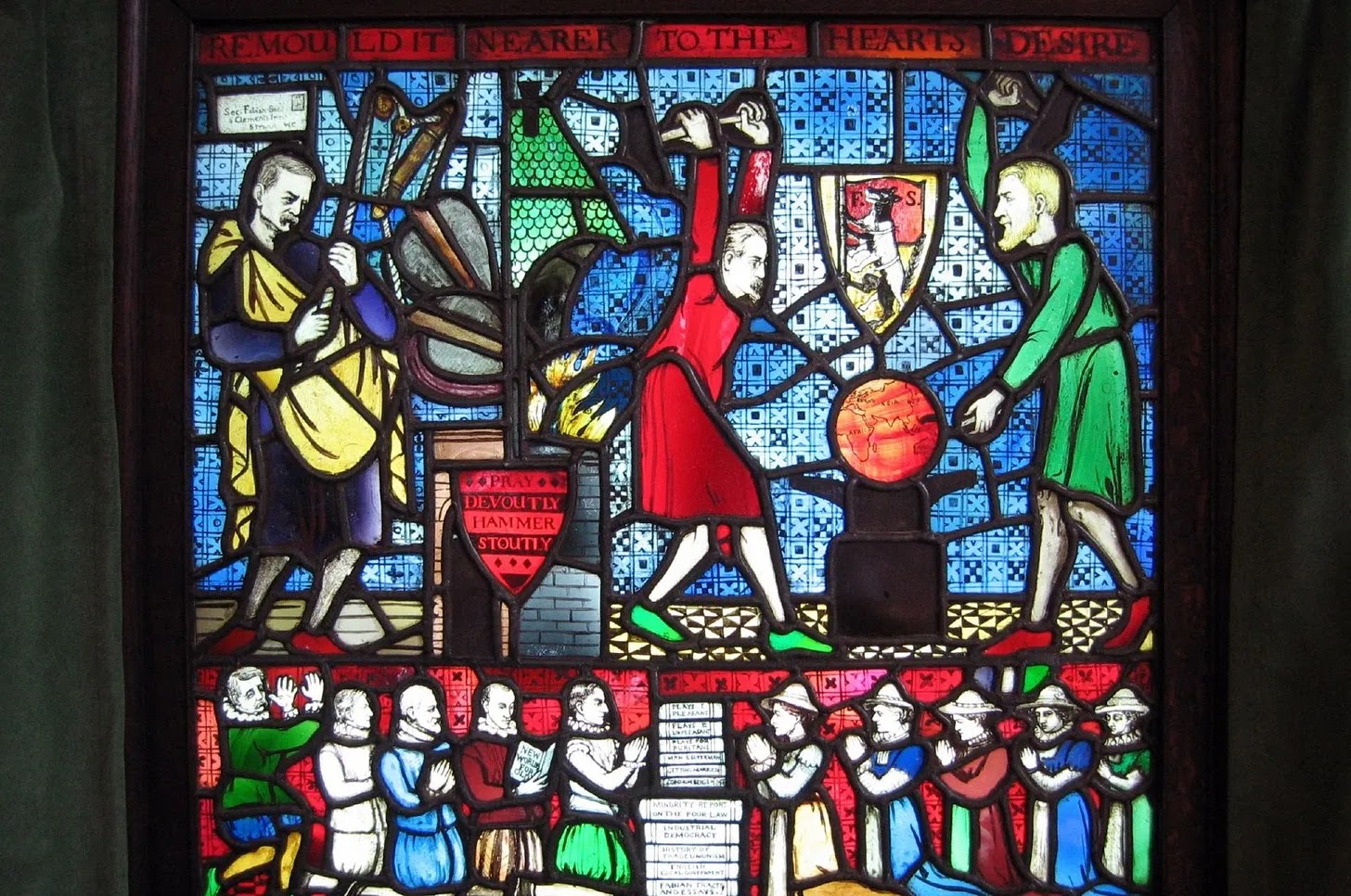
Headed by the motto "Remold it nearer to the heart’s desire,"
the famed Fabian window, designed by renowned Irish playwright George
Bernard Shaw, depicts its creator, alongside his fellow members,
hammering the Earth into a form of their own choosing. Today, the window
enjoys a prominent place within the London School of Economics, an
institution founded (with the aid of substantial Rothschild funding)
by Sidney Webb, Graham Wallas, and other leading Fabians. In
conjunction with initiates like Bertrand Russell and John Maynard
Keynes, the college has since served as the group’s primary recruitment
ground, in effect extending their reach beyond the working class
originally courted vis-à-vis The Labour Party, and into the most
consequential positions of British society.
Orwell’s Entry into the Corridors of Power
Born
Eric Arthur Blair on June 25, 1903, Orwell’s first breath of life,
although taken in the shadow of the Himalayan Mountains, was all but turgid with British colonialism,
his father Richard stationed in Motihari, India tasked with overseeing
the distribution of opium to China. The family were to spend only one
further year on the subcontinent before his mother Ida, a cultured and
faintly bohemian woman, took Orwell and his older sister Marjorie back
to England, raising the children alone until her husband’s eventual
return in 1912.
Despite these commitments, Ida’s
diary reveals an active and varied social life – a social life, it would
seem, which brought her into contact with a number of Fabians. Some of
these even boasted ties to the literary establishment and were thus
among the first to applaud her son’s early compositions, although it was
indisputably Ida’s sister Nellie, herself a suffragette and vitriolic socialist,
who did most to foster the young Orwell’s talent, helping not just in a
financial sense, but also in forging connections with agents and
publishers.
Nevertheless, it was not until 1916 that
the budding novelist would find himself ushered into Fabian circles.
Founded in 1440 by King Henry VI, Eton College is virtually synonymous
with Britain’s ruling elite, producing so many members of parliament
that it known as as "the chief nurse of England's statesmen." Orwell did
not fit in. Self-described as “lower upper middle class,” gaining entry
to the school only via a scholarship, his subsequent writings characterize his time at Eton
as one of resentment, loneliness, and cruel, sadistic bullying, yet for
all his apparent isolation, Orwell did manage to meet at least one
acquaintance who would become a lifelong friend – a French teacher by
the name of Aldous Huxley.

Huxley’s
own membership of the Fabian Society began during his time at Oxford,
the author acknowledging it as far back as his first published piece of
fiction, The Farcical History of Richard Greenow.
It was quite natural that his life would follow such a trajectory.
After all, the Huxleys constituted nothing less than an intellectual
dynasty, Aldous bonded, either by blood or by marriage, to a litany of
distinguished scientists, philosophers, artists and educators – his
grandfather Thomas Henry so instrumental in propagating Evolutionary
Theory that he became known as “Darwin’s Bulldog.” This represented the foundational text on which the family was raised, Huxley’s brother Julian,
himself a Fabian, going on to head both UNESCO and the British Eugenics
Society, in addition to cofounding the World Wide Fund for Nature. His
vision of progress was unambiguous:
“Consider
the problem of over-population. Rapidly mounting human numbers are
pressing ever more heavily on natural resources. What is to be done?...
We are given two choices -- famine, pestilence and war on the one hand,
birth control on the other. Most of us choose birth control.”
There is presumably no need to remind the reader of the analogies with Aldous’s work. Many may even contend that A Brave New World predicts even more astutely than does 1984,
the kind of technocratic caste system we find ourselves slipping into,
Huxley’s fictional citizenry anesthetized to the meaningless of their
existence, as we are increasingly anesthetized to ours, by a cocktail of
entertainment, promiscuity, and drugs. Given the author’s lineage, it
hardly seems a stretch to conclude that these insights were not purely
the product of creative prognostication, but more so an intimate
foreknowledge of the future he and his relatives were actively
attempting to precipitate.
Orwell’s Socialism
It is testament to both the enduring impact of 1984 as
well as the essential truths it contains that today, it is often those
quoting the novel most enthusiastically who prove most surprised – at
times even aggrieved – to learn of its author’s lifelong commitment to
socialism. In actuality, such sympathies were evident as early as his
first political book, The Road to Wigan Pier.
Documenting his two-month journey through England’s northern mining
towns, Orwell describes in vivid sordidness, a Britain quite at odd with
his regular London literary circles – the outer reaches of the country
emaciated by poverty, benighted by class prejudice, and suffused with a
squalor that at once kindled his sense of injustice and offended his
bourgeois sensibilities.
To his credit, Orwell was no
hand-wringing class tourist. In 1936, following the outbreak of civil
war in Spain, he immediately enlisted in the P.O.U.M - a
semi-independent Trotskyist faction within a broader coalition fighting
to repel Franco’s forces. As he notes in Homage to Catalonia,
the weeks prior to deployment were the first time the author had seen
his egalitarian ideals made manifest, saying of his time in Barcelona:
“There
is a sense in which it would be true to say that one was experiencing a
foretaste of Socialism, by which I mean that the prevailing mental
atmosphere was that of Socialism. Many of the normal motives of
civilized life—snobbishness, money-grubbing, fear of the boss, etc.—had
simply ceased to exist. The ordinary class-division of society had
disappeared to an extent that is almost unthinkable in the money-tainted
air of England; there was no one there except the peasants and
ourselves, and no one owned anyone else as his master.”
For
now, Orwell had no policy prescriptions of his own, merely pages of
observations and evocative, eloquent outrage. It was not until 1941 and
the publication of The Lion and the Unicorn: Socialism and the English Genius that these were to finally take shape.
At
the core of the book lies the assertion that a uniquely English brand
of socialism would arise, this iteration of the ideology distinguished
not by a desire to tear up the country by its roots, but rather a
willingness to build upon the quintessential trappings of Britishness.
Seemingly incompatible institutions such the Monarchy would survive, so
too a free press and Christian values, while the Empire, which at the
time still spanned a quarter of the planet, might be rebranded as “a
federation of Socialist states.” These “antagonisms,” as Orwell called
them, would calm the populace even as society was being rebuilt around
them, showing “a power of assimilating the past which will
shock foreign observers and sometimes make them doubt whether any
revolution has happened.” It was a vision, it seems superfluous to say, which found considerable favor among the Fabians.
Fabians and the Literary Elite
Right
from their very inception, the society had endeavored to use literature
in general, and fiction in particular, as a means of disseminating
their doctrine. Although George Bernard Shaw is widely remembered as a
dramatist of near peerless wit and penetrating social critique,
conceivably the most important playwright since Shakespeare, his work
remains inextricable from leftist dogma, Widower’s House and Mrs. Warren's Profession perhaps the most demonstrative examples. His politics were far less circumspect than Orwell’s. A vocal supporter of both Stalin and Stalinism,
alternatingly denying, defending and celebrating atrocities committed
by the USSR, Shaw’s convictions might be said to fall somewhere been
“proudly misanthropic” and “nakedly Malthusian,” the ideological basis
of which is best delineated in his play Man and Superman, a work that borrows as much from Darwin's theory of evolution as it does Nietzsche’s notion of the Ubermensch.
Unquestionably
the Fabian’s most prolific wordsmith, however, was H.G. Wells. The
author of over a hundred books, his literary corpus – still today the
bedrock of science fiction – gave rise to just about every trope within
the dystopian genre, whether it be the social stratification of The Time Machine, the scientific dictatorship in The Shape of Things to Come or the primitive transhumanism practiced on The Island of Dr. Moreau
– themes of selective breeding, inescapable surveillance, and
cradle-to-grave indoctrination pervasive throughout his work. Wells’
1940 publication New World Order, even served as the basis for the UN Universal Declaration of Human Rights while his most brazenly Fabian-inspired treatise, A Modern Utopia,
portrays a parallel Earth freed from the limiting tribalisms of
nationality and religion, its integrated and fluid population governed,
just as the writer and his radical cohorts envisaged, by a wise and
ethically upright order of “voluntary nobility.”
Orwell the Propagandist
While
it exceeds the scope of any one article to dissect the motivations
behind each component part of the Fabians’ literary output, what remains
clear is that, contrary to his present-day persona, there were
occasions Orwell likewise felt it permissible to manipulate public
opinion via the written word. When interviewed for a job at the BBC’s
Eastern Service, he indicated the absolute “need for propaganda to be directed by the government,"
stressing that during wartime – and presumably, crises more broadly –
objectives must be pursued without squeamishness or misguided loyalty to
the truth. His broadcasts to India, designed to counter German efforts
at undermining imperial links, were unabashedly agenda-driven yet his
connections to Britain’s PR apparatus ran deeper still. The Ministry of
Truth, where 1984’s doomed protagonist Winston
Smith performs his own reality-rewriting duties, was in fact modeled
after the country’s Ministry of Information, a building Orwell was
well-acquainted with, given his wife Eileen’s role in its censorship department.
In
Orwell’s defense, he left the BBC after just two years, heartily
disgusted by what he’d seen there. This habit of joining institutions
only to become quickly disillusioned by their inner workings had long
been a pattern for the self-professed idealist. His youthful involvement
in the Burmese Police had been fundamental to igniting Orwell’s disdain
for the British Empire while his months spent volunteering in Spain
only solidified his suspicion that leftist causes were doomed to
in-fighting. So too would the author cling to his collectivist
principles even as he grew more contemptuous of those who endorsed them,
deriding upper-crust socialists as “left-wing secret teetotalers with vegetarian leanings” who alienated the working class in favor of “the fruit-juice drinker, nudist, sandal-wearer, sex-maniac, Quaker, ‘Nature Cure’ quack, pacifist and feminist.”
Many
who earned his ire were, not unexpectedly, card-carrying Fabians. But
Orwell’s antipathy went beyond a basic misalignment of personalities. In
2003, after some fifty years of secrecy, the British government released a list compiled by the author
in which he identified 135 left-wing writers and artists as potential
"Soviet sympathizers." This he supplied to the British Information
Research Department, a secret branch of the Foreign Office operating
during the Cold War, earmarking for further scrutiny, Fabians such as
novelist Naomi Mitchison, journalist Kingsley Martin, archaeologist V.
Gordon Childe and even George Bernard Shaw himself.
Orwell: A Wolf in Sheep’s Clothing?
This
would certainly lend credence to the claim that Orwell’s masterwork was
written, at least in part, as a direct attack on the Fabians, warning
of the tyranny which would inevitably ensue if ever they were to realize
their objectives. This, while undeniably speculative, is not without
merit. Although the official story behind the book’s title asserts that
Orwell, upon advice from his agent, simply swapped the last two digits
of the year his manuscript was completed, it has also been suggested that the name was a thinly veiled reference to the society, 1984 marking their centennial anniversary. Further inferential evidence lies in the date of Winston’s first diary entry, April 4th, a day which falls exactly one hundred years since the publication of the Fabians’ original pamphlet.
Naturally,
all this begs the question, if Orwell really did wish to expose their
intentions, deriving his fictional hellscape from the blueprints he’d
heard discussed behind the closed doors of their meetings, then why did
he not categorically call out the Fabians by name?
Well, perhaps he did.
Upon
the death of the author’s second wife, Sonia – a woman he married just
months before succumbing to tuberculosis – the organization acquired (and then promptly sealed) the entirety of Orwell’s archives, representatives of publishing behemoth HarperCollins stating that the group will maintain the copyright of 1984 until later this year.

By
then, of course, regardless of what these documents reveal, it will
likely be too late to exorcise the poison from the wound. Following the
UK’s most recent elections, a total of 141 Fabians took their seats in parliament,
Keir Starmer ostensibly the most senior. In his little more than six
months as Prime Minister, the Labour leader has succeeded in
accelerating the already rapid overhaul of British life – importing wave upon wave of third-world migrants, running interference for their crimes, and pompously imprisoning citizens who might voice objection. But even he is merely an administrator. Further up the Fabians’ totem pole of power is Sadiq Khan,
the long-standing Mayor of London also chairing the C40 Climate
Leadership Group, a body charged with implementing the 15-minute city
initiative. More ominous still is Tony Blair, a WEF collaborator
and unapologetic war criminal whose steadfast support for open borders
and mass vaccinations, digital IDs and net zero self-immolation has
rendered him a living, breathing avatar for globalist aspirations.
Today,
these individuals and countless others like them, sit at the helm of a
vast and secretive empire. 140 years since the Fabian Society was
formed, this current crop of operatives at last possess the power and
the capacity, after generations of careful infiltration, to plunge
mankind into the centrally-planned, algorithmically-guarded prison
system first conceived by their predecessors. Theirs is a future, if
ever it materializes, defined by conformity and all-pervasive fear,
bereft of both humanity and the hope for anything better – a future that
was most accurately articulated, whether as cautionary tale or
confessional, by esteemed author, avowed socialist, and enigmatic member
of the Fabian Society, George Orwell.